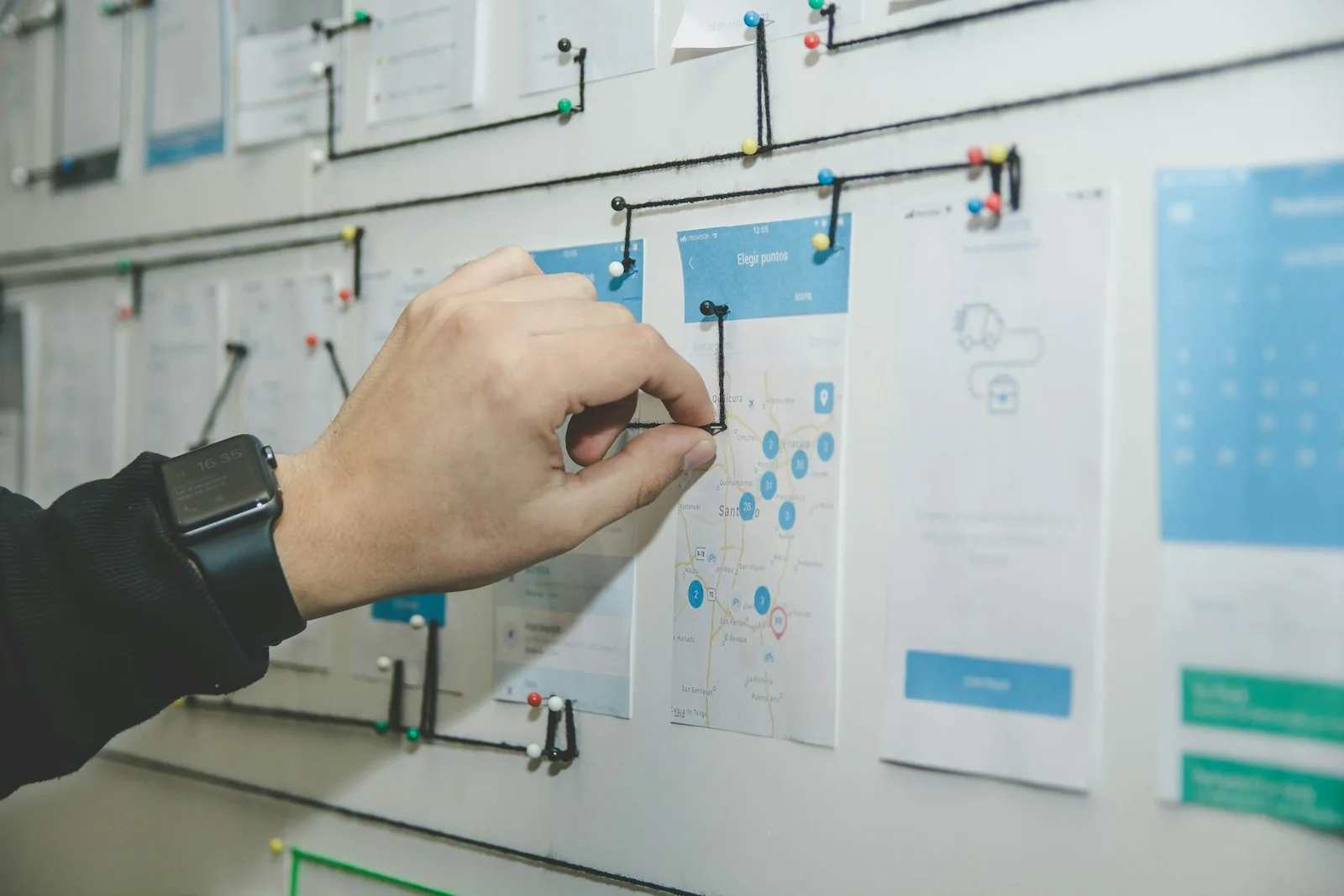
Our Methodology: The LOKAL Framework for AI Success
Adopting Artificial Intelligence is not about chasing the latest trend; it’s about making a strategic investment in the future of your business. A successful AI implementation requires a thoughtful, structured approach tailored to your unique context. At AI Consulting Bali, we have developed a proprietary methodology—the LOKAL Framework—to ensure every project we undertake is practical, impactful, and sustainable for Indonesian SMBs.
Our framework is designed to de-risk your investment and maximize your return, moving beyond generic advice to deliver a clear, actionable roadmap. Our commitment to this rigorous process is why our recommendations are trusted by businesses across Indonesia. It is a living system, constantly refined by our team of experts and governed by our strict editorial standards.
The LOKAL Framework: A Five-Step Process to AI Integration
Our methodology is built around five critical stages, ensuring a holistic approach from discovery to long-term success.
1. L – Latar Belakang (Background & Discovery)
We begin with a deep dive into your business. This is the most crucial phase, where we move beyond surface-level problems to understand the core of your operations. We conduct stakeholder interviews, map existing workflows, analyze your current technology stack (including local software like Mekari, Jurnal, or MokaPOS), and identify the specific pain points and opportunities where AI and automation can deliver the most value.
2. O – Objektif (Objective & KPI Setting)
With a clear understanding of your background, we work with you to define concrete, measurable objectives. We avoid vague goals like “improve efficiency.” Instead, we set specific Key Performance Indicators (KPIs) such as:
- Reduce customer inquiry response time by 40% using a ChatGPT-powered chatbot.
- Increase marketing lead qualification rate by 25% through an automated scoring system.
- Decrease manual data entry hours by 150 hours per month via an n8n workflow.
- Improve sales forecasting accuracy by 20% with a predictive analytics model.
These KPIs form the basis for measuring the project’s success and ROI.
3. K – Kelayakan (Feasibility & Solution Design)
Here, we evaluate the technical and financial feasibility of potential solutions. We compare different tools and platforms based on a strict scoring rubric (see below). We analyze the Total Cost of Ownership (TCO), potential integration challenges, and data security implications, ensuring full compliance with Indonesia’s UU PDP law. The output of this stage is a detailed solution design and a transparent pricing proposal for your AI consulting project.
4. A – Adopsi (Adoption & Change Management)
Technology is only effective if people use it. This phase focuses on the human element of digital transformation. We develop a comprehensive implementation plan that includes user training, creating clear documentation (in both English and Bahasa Indonesia), and establishing a feedback loop. Our goal is to empower your team, turn skepticism into advocacy, and ensure the new tools are seamlessly integrated into their daily routines.
5. L – Lanjutan (Longevity & Scalability)
Our partnership doesn’t end at launch. We design solutions built for the future. This final stage involves creating a clear plan for maintenance, monitoring performance against the initial KPIs, and identifying opportunities for future enhancements. We ensure your AI and automation systems can scale as your business grows towards 2026 and beyond, providing ongoing support to adapt to new challenges and technologies.
Our Technology Scoring Rubric
When evaluating tools like n8n vs. Make vs. Zapier, or LLMs like ChatGPT vs. Claude, we use a multi-criteria scoring system tailored for Indonesian SMBs:
| Evaluation Criterion | Description | Weighting |
|---|---|---|
| Cost-Effectiveness | Total cost of ownership, pricing scalability, and value for Indonesian Rupiah. | 30% |
| Integration Capability | Ability to connect with existing systems, especially local Indonesian software and platforms. | 25% |
| Scalability & Performance | The tool’s ability to grow with the business and handle increasing workloads reliably. | 20% |
| Security & Compliance | Adherence to data security best practices and compliance with UU PDP. | 15% |
| Ease of Use & Support | User-friendliness for non-technical staff and quality of available support. | 10% |
This structured, transparent methodology ensures that we deliver AI solutions that are not just technologically advanced, but are the right fit for your business, your budget, and your team.
Continue exploring AI Consulting Bali:
Our AI Consulting Bali Service ·
Meet Our Team ·
Editorial Standards ·
Methodology ·
Sustainability ·
Safety & Compliance
In Bali, that evaluation also has to account for multilingual teams, tourism and hospitality workflows, and distributed stakeholders across time zones.[1][2]
- Start with the business problem: revenue, cost, speed, or risk reduction.[4]
- Check production readiness: data quality, integration, security, and governance.[2][6]
- Compare total cost: advisory, implementation, and ongoing support.[2][9]
Define the business outcome before comparing tools
The first filter in our methodology is whether an AI option solves a specific business outcome, not whether it looks impressive in a demo. AI consulting is most effective when the problem is framed in operational terms such as reducing response time, improving lead qualification, cutting repetitive admin, or increasing forecast accuracy.[1][2]
We evaluate each request against three practical business levers: profit, growth, and risk. Profit covers cost reduction and productivity gains; growth covers acquisition, retention, and expansion; risk covers compliance, errors, and service inconsistency.[4] This prevents teams from selecting a tool that creates extra complexity without a measurable payoff.
For Bali-based companies, that usually means mapping the use case to guest messaging, booking workflows, internal knowledge access, sales follow-up, or content operations. The strongest candidates are the ones that can be described in one sentence, measured with one or two KPIs, and implemented without replacing the entire operating stack.[2][6]
Score data readiness before any pilot begins
Most AI failures are not model failures; they are data and process failures.[2] Our evaluation therefore checks whether the inputs are complete, current, structured enough, and legally usable for the intended use case. If a team cannot reliably access the relevant records, documents, or support history, then even a strong model will produce inconsistent results.[1][2]
We review where the data lives, who owns it, how often it changes, and whether it contains sensitive information that should not be sent into external systems. We also look at whether the team already has a repeatable workflow, because AI works best when it is attached to a stable process rather than used to patch confusion.[2][6]
This step is especially important for companies operating across tourism, hospitality, property, wellness, and e-commerce in Bali, where teams often combine spreadsheets, chat platforms, booking systems, and informal handoffs. The right AI solution should reduce that fragmentation, not add another interface that needs constant supervision.[1][2]
Test workflow fit, not just feature lists
Our methodology checks how the solution behaves inside the real workflow, including who uses it, when they use it, and what happens if the output is wrong. A useful AI system should fit into daily operations with minimal friction, because adoption usually depends on whether staff can trust it and understand when to override it.[2][4]
We map the workflow from trigger to action: what starts the task, what information the system needs, what output it produces, and which human approves the result. This matters because many AI tools are technically capable but operationally awkward. If the team must leave its primary system to use the AI, adoption drops and ROI becomes harder to prove.[1][8]
We also evaluate language coverage, response consistency, and handoff quality for teams serving international visitors or working in bilingual environments. For AI consulting Bali projects, that usually includes checking whether the tool can support English and Indonesian interactions, preserve brand tone, and scale without requiring extra admin hours.[1][8]
Compare governance, privacy, and deployment risk
AI evaluation should include governance from the start, not after the pilot has already been approved. Our review checks how the solution handles access control, auditability, data retention, human review, and escalation when the system is uncertain.[2][6]
This is where many vendors differ sharply. Some tools are good for brainstorming or drafting but offer limited controls for sensitive business data. Others support stronger deployment patterns but require more setup and internal discipline. We compare those trade-offs directly so clients can choose between convenience and control with clear eyes.[2][6]
For organizations in Indonesia, we also consider whether the deployment model fits local compliance expectations and internal policy requirements. If a workflow touches customer records, payment data, or employee information, the safest option is usually the one that limits unnecessary exposure and provides a clear review trail for staff and management.[2][6]
Measure ROI using pilot metrics that leadership can verify
An AI pilot is only useful if the results can be measured against a baseline. We define the pilot metrics before implementation so the team knows what success looks like and can decide whether to expand, revise, or stop the project.[2][4]
Common metrics include time saved per task, reduction in error rate, response-time improvement, lead-to-meeting conversion, support deflection, content turnaround time, and manager review time. For some projects, the best metric is not direct revenue but risk reduction or staff capacity, especially when the work is repetitive and high-volume.[1][2]
We also check whether the KPI can be tracked without adding too much reporting overhead. If measurement becomes a burden, the project may look successful on paper while delivering little operational value. A strong methodology makes the pilot simple enough for leadership to validate and realistic enough for frontline teams to maintain.[2][7]
Compare pricing models before committing to a scope
AI consulting pricing varies widely because scope, implementation depth, and governance requirements differ so much across projects. Broad market guidance puts consulting at roughly $100 to $1,200+ per hour, $10,000 to $5,000,000+ per project, or $2,000 to $150,000 per month on retainer, depending on the firm and engagement type.[2]
For a Bali business comparing options, a practical planning range for a focused discovery and evaluation engagement is often about $3,000 to $12,000, or roughly IDR 48 juta to IDR 192 juta, while a more complete implementation project can move much higher depending on integrations, security, and change management. These are ballpark planning figures, not fixed rates, because the real cost depends on data complexity and deployment requirements.[2][9]
We compare proposals on three dimensions: what is included, what is excluded, and what must be added later. That approach is more useful than comparing only headline prices, because a low-cost pilot can become expensive if it needs extra integration, governance, or manual support after launch.[2][9]
How this methodology answers common client FAQs
Clients often ask which AI solution is “best,” but the better question is which solution fits the team’s current readiness. Our methodology is designed to answer that by checking business need, data quality, workflow fit, governance, and economics in sequence rather than in isolation.[1][2]
Another common question is whether to start with automation, a chatbot, predictive analytics, or a custom model. The answer depends on where the highest-friction work sits. If the process is repetitive and structured, automation may be enough; if the work depends on language or knowledge retrieval, a conversational layer may be better; if forecasting matters, predictive models may be the right fit.[1][8]
Clients also ask how long evaluation takes. A focused discovery and prioritization phase can be short, but a credible decision usually needs enough time to review data, interview stakeholders, test workflow fit, and define success metrics. That is the difference between buying a tool and building an AI capability that can actually support the business.[2][6]
For related context, see our AI Consulting Bali homepage, our about the team, and our AI consulting services. You can also review our contact page if you want a structured evaluation for your current workflow.
For local and authoritative background, refer to Indonesia’s official tourism portal, Indonesia’s official government portal, and the general definition of artificial intelligence on Wikipedia.
If you want a practical review of your current AI options, contact the team through our contact page and share the workflow, tools, and outcome you want to evaluate.